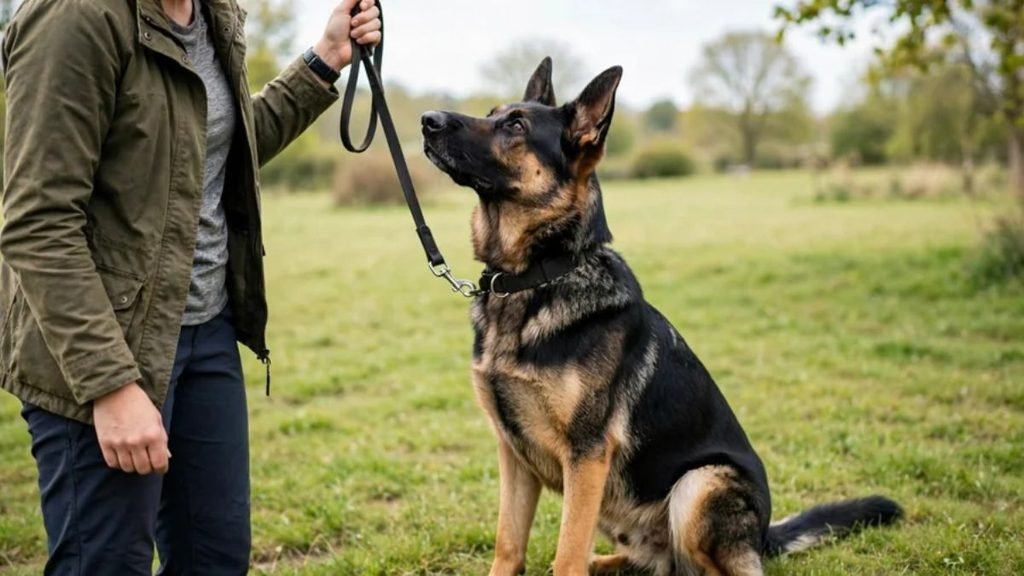
Dog training GSD is not about slowing down a difficult dog. It is about aiming a fast learner in the right direction.
Most guides on how to train a German Shepherd list commands without teaching them, or lock the teaching in a paid course. This one teaches: a marker system, five cue protocols, and a 4-week plan. German shepherd training rewards owners who are clear, consistent, and brief.
Key Takeaways
- Shepherds learn good and bad behavior at the same speed, so clear rules matter from day one.
- A marker sound, charged in minutes, sharpens your timing.
- Five cues carry daily life: name, come, sit and down, leash walking, and settle.
- Five-minute sessions, four to six a day, beat one long session.
- Adolescence (6 to 18 months) brings a temporary wobble, not failure.
What Makes Dog Training GSD Different
A German Shepherd was bred to work beside a person all day: herding, police, military, and service dog training work. That history built a dog that bonds hard and gets bored within minutes. The facts below are the American Kennel Club figures.
| Fact | German Shepherd |
| Group | Herding |
| Origin | Germany |
| Height | Males 24 to 26 inches, females 22 to 24 inches |
| Weight | Males 65 to 90 pounds, females 50 to 70 pounds |
| Life span | 9 to 13 years |
| Temperament | Confident, courageous, smart |
Working Line vs Pet Line: Same Breed, Different Settings
Working-line shepherds, bred for police and sport work, run hotter. Pet and show lines are calmer, but need the same cues and rules. What changes is the setting: working-line dogs need shorter sessions and higher-value rewards. The same split shapes dog training for belgian malinois plans too.
Why Smart Dogs Learn the Wrong Lesson Fast
Your shepherd is learning all day, even when nobody is teaching. Example: he barks at the window, the mail carrier walks away, and barking got paid. Example: he pulls toward a lamppost, he arrives, and pulling got paid too. Training is you joining that process on purpose.
Before You Start: The Dog Training GSD Setup
Good dog training GSD results start before the first cue. Keep sessions to 5 minutes, four to six times a day, with treats from the daily ration.
Gear You Actually Need
A treat pouch, treats, a front-clip harness, a 6-foot leash, a long line, and a mat. Skip choke, prong, and shock collars: they teach through discomfort.
The Marker: Your Dog Training GSD Timing Tool
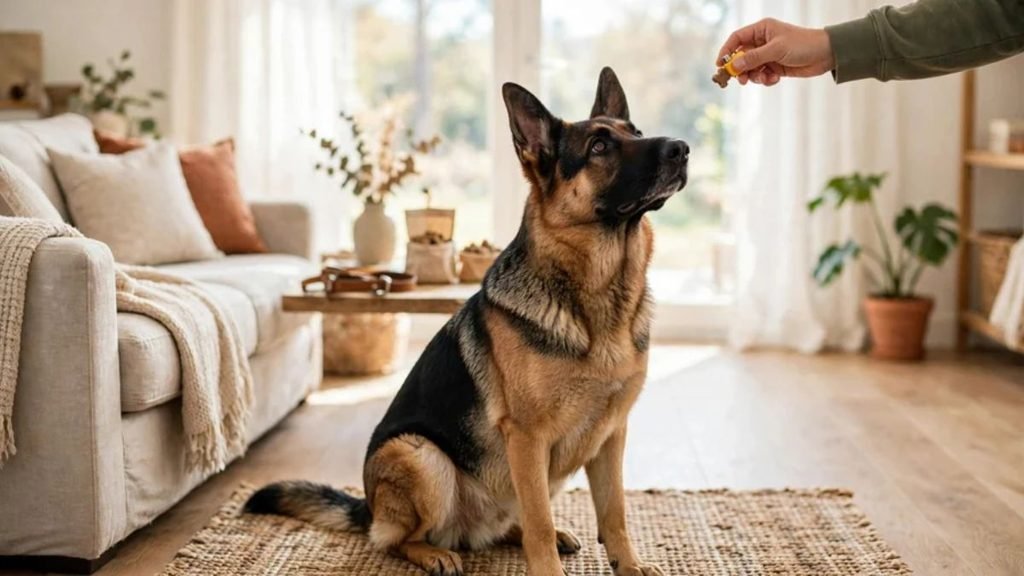
A marker is a short sound, a clicker or the word “yes,” that means: that exact thing earned a reward. Mark the instant a bottom hits the floor, feed a second later, and your dog knows what got paid. This is the engine inside positive reinforcement dog training.
Charge it first: click or say “yes,” hand over a treat, ask for nothing, 20 times, twice a day, for two days. When his head snaps toward your hand, the marker is loaded. For clicker fans, the same steps are in our guide to clicker training for dogs.
The 5 Foundation Cues: Dog Training GSD Protocols
Teach these five before any trick. If your dog fails twice in a row, the step is too hard: drop back one step and rebuild.
Cue 1: Name Response
Say your dog’s name once, in a bright voice, and the moment his head turns, mark and pay. Practice 20 times a day, scattered through normal life, and never use his name to scold him.
Cue 2: Come (Recall)
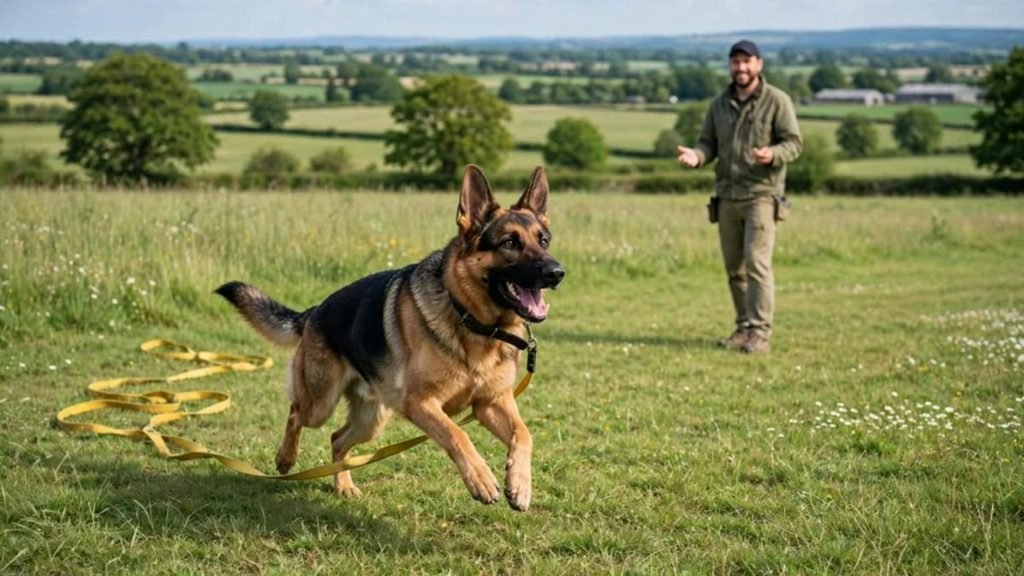
Recall keeps your dog alive, so pay for it like it matters. Start indoors: say “come” once, step backward, and throw a small party with high-value food on arrival. Then move to the yard on the long line: let him wander, say “come,” and pay hugely on arrival.
Cue 3: Sit and Down
Lure a sit once or twice with a treat moving up over his head, and mark the moment his bottom lands. Then switch to an empty hand signal, and add the word “sit” once he offers it quickly. Down follows the same pattern: lure from a sit toward the floor, and mark when his elbows touch down.
Cue 4: Loose-Leash Walking
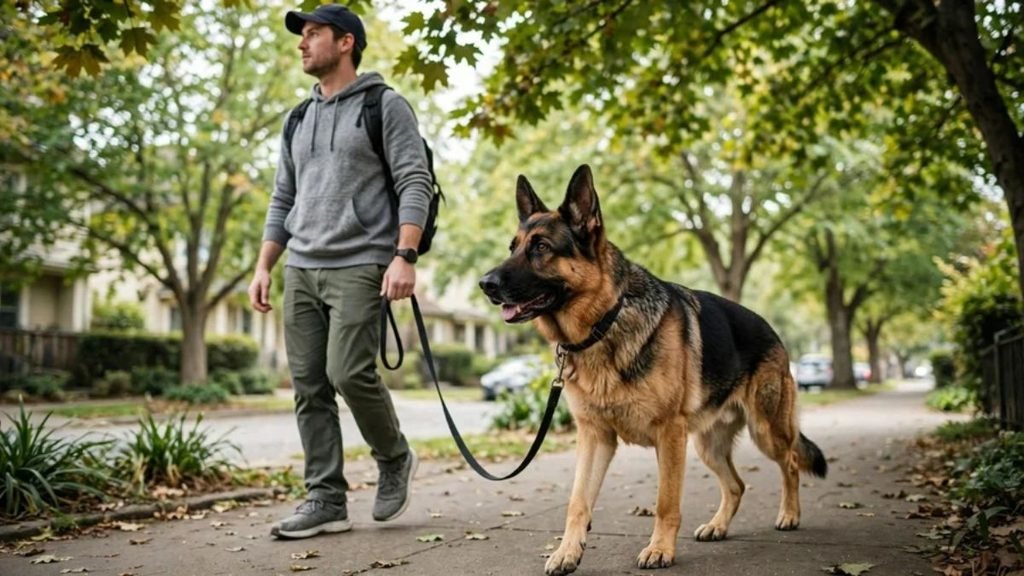
A 70-pound shepherd that pulls is not a small problem, so set the rule early: tight leash stops the walk, loose leash keeps it moving. The second the leash tightens, stop; when he turns back and it loosens, mark, pay at your leg, and walk on.
Cue 5: Settle on a Mat
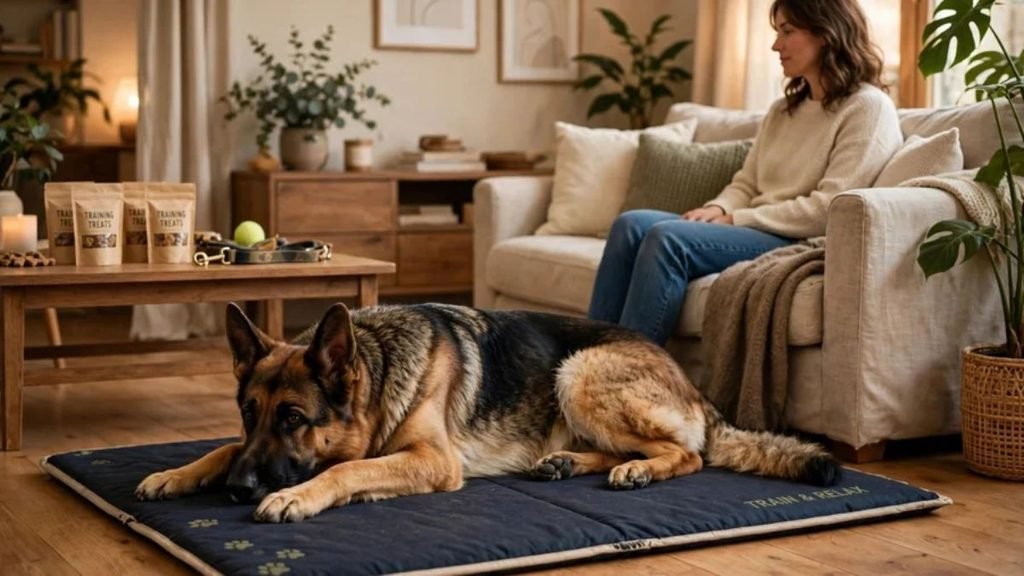
Put the mat down, and mark and pay any interest in it, then lying on it, with treats fed in a slow drip. Add the word “settle” once he heads there on his own, and build duration in small jumps: 10 seconds, then 30, then a minute. Example: the doorbell rings, your dog goes to his mat, and you answer in peace.
Your 4-Week Dog Training GSD Plan
This plan assumes a puppy or adult starting from zero: one new focus per week, earlier cues in short rotation.
Week 1: Start Dog Training GSD at Home
Charge the marker, and teach name response and sit. Set the house rules from day one: where the dog sleeps, no feeding from the table, calm doors. Keep everything indoors or in your yard.
Week 2: Down, Settle and First Walks
Add down, and start settle on the mat, building toward one quiet minute. Begin loose-leash practice in the yard, then on a quiet street.
Week 3: Recall on the Long Line
Move recall outdoors on the long line, in the quietest field you can find. Add a simple leave it: a treat in your closed fist, paid from the other hand the moment he backs off.
Week 4: Proofing in Real Places
Take the known cues to harder places, one dial at a time: a busier street or a friend’s yard. Shorten distances and raise treat value there, then rebuild. Owners who enjoy structured breed systems can continue with our dog training siberian husky guide, which builds recall and leash skills the same way.
Dog Training GSD by Age: Daily Numbers
Too little work brews misbehavior, and too much, too young, strains growing joints.
| Age | Training time | Exercise guide | Main focus |
| Puppy (8 weeks to 6 months) | 5-minute sessions, 4 to 6 a day | 5 minutes per month of age, twice daily | Name, marker, socialization, crate |
| Adolescent (6 to 18 months) | 5-minute sessions, 3 to 5 a day | 60 to 90 minutes total | Proofing basics, recall on a long line |
| Adult (18 months to 7 years) | 5 to 10-minute sessions, 2 to 3 a day | 90 minutes to 2 hours total | Real-world reliability, a job or sport |
| Senior (7 years and up) | Short, gentle sessions | 45 to 60 minutes, low impact | Maintenance, scent games, comfort |
Puppy (8 Weeks to 6 Months)

The sensitive socialization window runs through roughly the first 16 weeks, so calm meetings with people, vaccinated dogs, traffic sounds, and new surfaces matter more than any cue. In gsd puppy training, teach name, marker, sit, and gentle handling of ears, paws, and mouth, paid every time. Start alone-time in minutes, and protect sleep: an overtired puppy bites and learns badly.
Adolescent (6 to 18 Months): The Hard Phase
Hormones and confidence arrive together, and solid cues wobble in public, but this is development, not defiance. Put the long line back on, return to easier places, and shorten sessions to two or three minutes.
Adult and Rescue: The First 2 Weeks
An adopted adult shepherd does not need a test on day one; he needs a routine. For two weeks, keep life small and predictable: same feeding times, same route, same sleeping place. Teach name and marker first, as you would a puppy, before asking for hard things.
Troubleshooting Dog Training GSD: When Cues Fail
When a cue falls apart, generic gsd training tips will not save you.
| Problem | Likely cause | Fix |
| Ignores you outdoors | Taught only in one room | Retrain in the new place at an easier level |
| Breaks the stay early | Duration was raised too fast | Return to the last length that worked, build smaller |
| Recall fails at a distance | Distance grew faster than reliability | Shorten distance, raise reward value, keep the long line on |
| Pulling returns on new routes | New smells, higher excitement | Stop at the first pull, reset, pay check-ins more often |
| Listens only when a treat shows | The treat became a bribe, not a payment | Hide treats in the pouch, mark first, then reach |
6 Dog Training GSD Mistakes That Slow You Down
Mistake 1: Skipping the Marker in Dog Training GSD
Without a marker, your reward lands seconds late, and a shepherd connects it to whatever he did last. Ten minutes of marker charging fixes your timing for good.
Mistake 2: Sessions That Run Too Long
Past five minutes, most young dogs get sloppy, and the last repetitions are the ones that stick. Four short sessions teach more than one long one.
Mistake 3: Repeating the Cue Louder
Say “come” five times and your dog learns the cue is the fifth one, delivered at volume. Say it once. If nothing happens, the setup was too hard: make it easier and rebuild.
Mistake 4: Raising All Three Dials at Once
Distance, duration, and distraction are separate dials. A dog that holds a settle in your kitchen cannot do it on a busy sidewalk, and that is not stubbornness. Change one dial, let him win, then change the next.
Mistake 5: Exercise Without Mental Work
Owners often answer shepherd energy with more running, but a fitter body can still have a bored brain. Balance it with nose and mind work: training, scent games, and chew time. For puppies, follow the five-minutes-per-month guide in the age table.
Mistake 6: Harsh Corrections on a Sensitive Breed
German shepherd obedience training built on fear suppresses behavior in the moment, but teaches the dog that the world is unpredictable. Veterinary behavior specialists recommend reward-based methods and warn that dominance-based techniques raise fear and aggression risk.
How Long Does Dog Training GSD Take?
These timelines assume short daily practice.
| Cue | First success | Reliable at home | Reliable outdoors |
| Name response | Day 1 to 2 | End of week 1 | Week 3 to 4 |
| Sit and down | Days 2 to 4 | Week 2 | Week 4 |
| Settle on a mat | Week 1 | Week 3 | Month 2 to 3 |
| Loose-leash walking | Week 2 | Week 4 | Month 2 |
| Come (recall) | Week 2, on a long line | Week 4 at short range | Month 3 and beyond |
Frequently Asked Questions
Are German Shepherds Easy to Train?
Yes and no. A shepherd is easy when the rules are clear and everyone follows them, and difficult when the rules change by person or by room.
At What Age Should I Start Dog Training GSD?
Start the foundations at 8 weeks: name, marker, handling, and socialization. Starting late is not a disaster either: adults learn the same system, often faster than puppies because their focus lasts longer.
How Much Exercise Does a German Shepherd Need Daily?
A healthy adult needs roughly 90 minutes to 2 hours of total daily activity, split across the day. Puppies need far less, about 5 minutes per month of age twice a day, while their joints develop.
Can I Train an Adult or Rescue German Shepherd?
Yes, this plan was written to allow it. Begin with two quiet weeks of routine, teach the marker and name response first, then follow the same 4-week plan.
Does a German Shepherd Need a Dominant Owner?
No. He needs a clear and consistent one. The dominance model came from old wolf studies their own researchers later corrected. What works is controlling what pays: reward the behavior you want, and manage situations your dog cannot handle.
Dog Training GSD: Start Week 1 Tonight
Start tonight: charge the marker with 20 treats, mark the first sit, and Day 1 of your dog training GSD plan is done.
Start tonight: Download the free 7-Day Starter Checklist and check off Day 1 before your next walk.
Disclaimer
This article is general educational information for dog owners, not a substitute for a qualified trainer or veterinarian who can see your dog in person. German Shepherds are large, powerful dogs. If your dog shows aggression, fear-based reactivity, or any behavior that worries you, work with a certified professional trainer or veterinary behaviorist in person. Always supervise training around children, and stop any exercise that causes pain or limping and consult your vet.